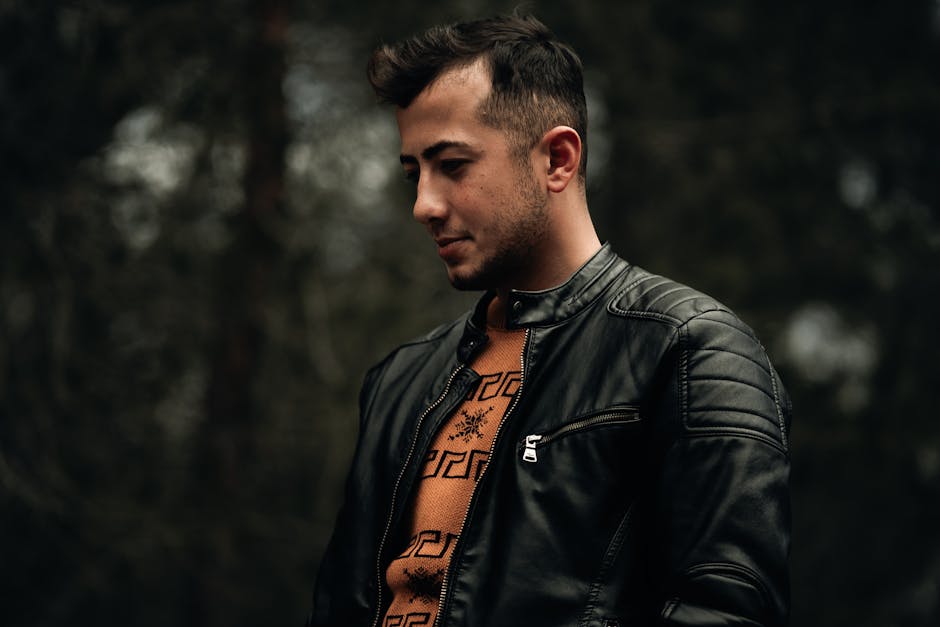
What actually separates a $150 jacket from a $600 one — and is the difference worth it in New Zealand? That question has a real, specific answer. Here it is.
How to Tell Real Leather From Fake Before You Hand Over $400
Most jackets marketed as “leather” in NZ are not leather. That is not an exaggeration. Walk through any Kiwi mall and roughly half the jackets labelled “leather look” or “faux leather” — and sometimes just “jacket” with nothing else — are polyurethane-coated fabric. Which is fine, if that is what you want. But if you are spending $350-plus expecting real cowhide, you need to know the difference before you buy.
The Three-Second Physical Test
Real leather is warm to the touch. PU is cold and slightly plasticky. Press your hand against the jacket and hold it there. Real leather absorbs body heat within seconds. PU stays cold longer.
Real leather also has natural grain variation — no two patches look identical. PU is perfectly uniform, almost too consistent. Look closely at the surface pattern and you will see it repeating at regular intervals.
Bend the material. Real leather creases naturally and springs back slowly. PU creases sharply or crinkles with a faint sound. Smell it: genuine leather has an earthy, slightly animal smell. PU smells like plastic, faint chemicals, or nothing at all.
Check the cut edges. Look at the back of a collar, inside a pocket, or along the hem. Real leather shows a fibrous, slightly rough cross-section — almost like dense felt. PU shows a smooth fabric backing or a clean plastic edge.
What the Label Actually Tells You
NZ consumer law requires accurate material labelling on clothing. “100% genuine leather” means real animal hide. “Bonded leather” is different — it is leather scraps and fibres pressed together and coated in polyurethane, typically 10-20% actual leather content. It looks convincing for about a year, then starts peeling from the seams outward. Avoid bonded leather for any jacket you expect to last.
“Faux leather”, “vegan leather”, “PU leather”, “eco leather” — these all mean plastic fabric. Not inherently bad. Just honest about what they are.
When Faux Leather Is Actually the Smarter Buy
If you are buying a fashion piece you expect to replace in two or three years, a well-made PU jacket at $100-$180 NZD makes more financial sense than stretching to $450 for genuine leather. Real leather is worth the price when you want something that improves with age, can be repaired and reconditioned, and will look better in year five than it did in year one. That is the actual value proposition — not that it looks better on day one, but that it keeps getting better as it wears in.
PU does the opposite. It looks its best new and degrades from there. Neither outcome is wrong. They just suit different buyers.
Which Leather Jacket Style Actually Suits NZ Life
There are four leather jacket silhouettes worth knowing. They are not interchangeable, and buying the wrong one for your lifestyle is a more common mistake than buying the wrong quality level.
| Style | Key Features | Best For | Not Great For | NZ Weather Rating |
|---|---|---|---|---|
| Moto / Biker | Asymmetric zip, snap collar, often belted waist | Casual outfits, layering over hoodies or knitwear | Office settings, formal occasions | Good — collar and belt block wind effectively |
| Bomber | Ribbed cuffs and hem, centred zip, shorter cut | Weekend wear, most versatile layering piece year-round | Very formal settings | Excellent — ribbed hem traps warmth better than open hems |
| Blazer / Moto Hybrid | Structured shoulders, minimal hardware, lapels | Smart-casual, NZ office environments | Streetwear, outdoor activities | Moderate — less wind protection, more tailored fit |
| Shearling / Sherpa | Wool or fleece lining visible at collar and cuffs | Cold South Island winters, looks expensive at mid price | Wet Wellington days — shearling gets heavy when damp | Warmest when dry, problematic in rain |
For NZ’s climate — cold mornings, variable afternoons, occasional sideways rain — the bomber silhouette wins on pure versatility. The ribbed hem seals warmth better than an open moto hem, and the simpler hardware means it pairs with more outfits across more occasions.
The moto jacket is the style people usually picture when they say “leather jacket.” It is a great piece, but the asymmetric zip and heavy hardware can narrow how you style it. If this is your first leather jacket, a bomber gives you more wearable days per year in most NZ cities.
Shearling jackets are genuinely warm but take a real hit in wet conditions. Wellington in July in a shearling jacket is uncomfortable if it rains — and in Wellington, it always rains. For Queenstown winters or Canterbury cold snaps, they earn their place. For Auckland or coastal towns, the bomber or moto will serve you better most of the year.
One tip that applies across all styles: avoid moto jackets loaded with decorative straps, non-functional buckles, and extra zips. They look striking in product photos and feel heavy and awkward within a week of wearing. The best versions keep hardware purposeful.
What Good Leather Actually Costs in NZ Right Now
Here is where most guides go vague. They say “expect to spend $300-$800” and leave it there. That is useless. Here is what each tier actually buys you:
| Price Range (NZD) | What You’re Getting | Representative Brands | Realistic Lifespan |
|---|---|---|---|
| $80 – $200 | PU / faux leather. Fashion piece, not a long-term investment. | Glassons, Zara NZ, ASOS standard range | 2-4 seasons with care |
| $250 – $450 | Entry-level genuine leather, thinner hides, basic lining, decent construction. | Barkers, Country Road, Hallensteins | 5-8 years with annual conditioning |
| $500 – $900 | Full-grain or top-grain leather, heavier weight, better lining and hardware. | Allsaints, Selected Homme, Nudie Jeans | 10-15 years minimum |
| $900 – $1,500+ | Premium hides, proper construction, heritage craftsmanship throughout. | Schott NYC, R.M. Williams, Acne Studios | Decades — genuinely heirloom quality |
The jump from $200 to $450 is the most meaningful one. That is where you cross from PU to genuine leather — a material that behaves completely differently over years of wear. The jump from $450 to $900 is subtler: better hide quality, heavier weight, more durable hardware. Most people will not notice the difference on day one. After three years of regular wear, the gap becomes obvious.
The practical sweet spot for most NZ buyers is $350-$550 NZD. That range gets you real leather that will last a decade without costing what some people pay in monthly rent.
One thing worth knowing specific to NZ: imported brand prices shift with the exchange rate. Allsaints and Schott NYC can fluctuate 10-15% in NZD terms within a single year. If you are watching a specific jacket, do not assume the price from six months ago is still current. Check before you commit.
Brands Selling Leather Jackets in NZ and Honest Verdicts on Each
Here is what is actually available and what it is actually worth.
Allsaints — The Best Mid-Range Option Shipping to NZ
Allsaints ships directly to NZ and is the most consistent mid-range option available. Their Cargo Leather Biker and Bassline Leather Bomber run $450-$650 NZD depending on the exchange rate at the time. The leather is genuine lamb or cowhide depending on the style — noticeably heavier than anything from a mall brand. The hardware does not rattle. Sizing runs slightly slim; if you are between sizes, go up one.
My clear pick in the $450-$700 range: Allsaints over everything else at this price point. Reliable quality, accurate fit guides, and the jackets hold up across years of real use. Returns work without drama if the fit is wrong.
Generic tip: Whatever jacket you buy, purchase a leather conditioner at the same time. Leather Honey ($20-$30 NZD from Autobarn or online) and Leather CPR are both excellent products. Apply every 6-12 months. This one habit, more than anything else, extends the life of a genuine leather jacket. Skip it and even a $600 jacket starts cracking within five years.
Schott NYC Perfecto 618 — The Standard Everything Else Is Measured Against
The Schott NYC Perfecto 618 is the original motorcycle jacket. Every biker jacket designed since 1928 has borrowed from its template. In NZ you are ordering it online — expect $750-$950 NZD landed, depending on which international retailer you source from. It is cowhide, genuinely heavy at around 1.5kg, and built to survive a crash. That is literally its design origin.
This is the jacket that makes no compromises. The weight is real. The break-in period is real — expect three to four months of regular wear before it fully softens and conforms to your body. But once it does, it will outlast most other things you own.
It is a specific, committed look and a committed purchase. If you want something for smart-casual Fridays, this is not the right jacket. If you want a moto jacket that a future generation might inherit, it is.
Barkers and Country Road — The Best In-Store Options in NZ
For trying before buying, Barkers (menswear, jackets $350-$499 NZD) and Country Road ($299-$459 NZD) both carry genuine leather jackets at retail locations across NZ. Quality is mid-range — thinner hides than Allsaints, but real leather and solid construction. Country Road does a particularly clean moto-blazer hybrid that works for smart-casual NZ workplaces. Barkers tends toward cleaner silhouettes with less hardware, which ages better.
Generic tip: When trying on leather jackets in-store, wear the actual layers you would wear underneath in real life — not just a t-shirt if you normally layer over a knit. Leather has minimal stretch compared to fabric, so fit with your real-world outfit matters more than fit in isolation.
Glassons and Zara — Good PU at an Honest Price
Glassons faux leather jackets ($89-$130 NZD) and Zara’s PU options ($120-$200 NZD) are both well-made for what they are: fashion pieces with a defined lifespan. Both are upfront about the material. No issue with that. Just do not expect them to look as good in year three as they do in year one — that is not what they are built for, and it is not a fair standard to hold them to.
Buy It Slightly Snug. Leather Stretches.
Leather stretches along the grain, conforms to your body, and never returns to its original shape. A jacket that fits perfectly in the shop will feel noticeably looser by year two. Buy it so the shoulders sit correctly — shoulder seams cannot be realistically altered after purchase — and accept that the chest and waist will give over time. If it feels snug across the torso on the first try, that is usually correct.
This is the most common mistake NZ buyers make. They bring the jacket back to the store months later, it is hanging off them, and they cannot understand what happened. The jacket did exactly what leather always does.
Second-Hand Leather in NZ — Worth It or a Waste of Time?
TradeMe, Facebook Marketplace, and op shops like Recycle Boutique and Savemart have a steady supply of leather jackets. This is genuinely one of the best-value routes in the entire category. But it requires knowing what to look for so you do not spend $150 on something that cannot be saved.
What Makes a Second-Hand Jacket Worth Buying?
Look for even patina — that darkening and softening that comes from years of regular use. Good patina is uniform across the jacket, not patchy. Patchy wear usually means the leather dried out and cracked in specific areas, which is difficult to fully reverse even with conditioning.
Check the lining. A torn or completely missing lining is a sign the jacket was not cared for — lining takes significant stress and its condition reflects how the whole piece was treated. Budget $50-$100 NZD for a tailor to replace lining if the leather itself is in good shape. It is usually worth the cost.
Examine the seams under good light. Leather is stitched with heavy thread, and intact seams mean the jacket is structurally sound. Separating seams can be repaired by a cobbler — not necessarily expensive, but worth accounting for in what you offer the seller.
When Should You Walk Away?
Walk away if the leather is cracking through — not surface scratches, but actual splits through the hide itself. Walk away if it smells strongly of mildew. That smell is nearly impossible to fully eliminate and signals moisture damage deep in the hide. Walk away if the surface is peeling in sheets — that is bonded leather disintegrating, and it has no repair.
What Is a Fair Price on TradeMe?
Genuine leather jackets in good condition on TradeMe typically list for $80-$250 NZD. Anything under $60 for “genuine leather” needs extra scrutiny — check all three tests from the first section before committing. A jacket with an original retail value of $500, solid seams, even patina, and no mildew at $150 is the best-value buy in this entire category. Pick up a leather conditioner when you collect it and treat the jacket within a week. That is usually all a well-kept but neglected leather jacket needs to look properly cared for again.